CNC milling tools are essential in precision machining, enabling accurate shaping and fine surface finishes. Understanding their types helps manufacturers choose the right tool for each operation.
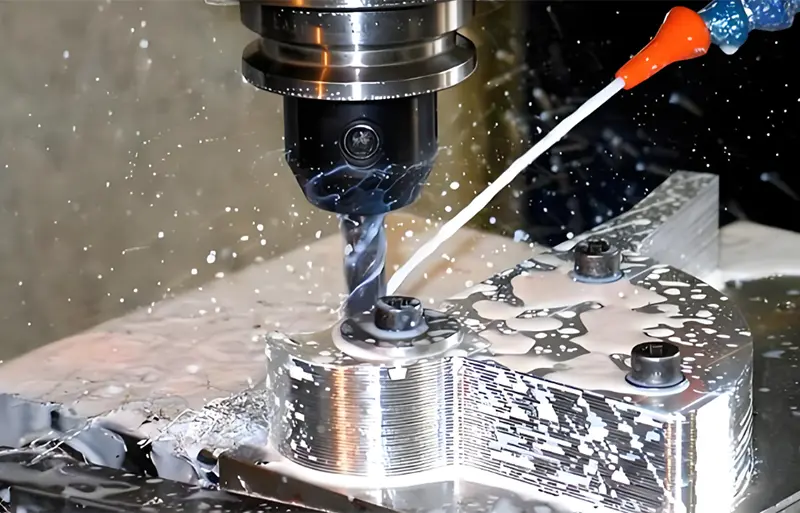
1. CNC Milling Tools
Milling tools are among the most versatile CNC machine tools, capable of producing complex 3D geometries and fine surface finishes. They work by rotating cutting edges against a stationary workpiece.
Common milling tools include:
- End Mills: Ideal for contouring, profiling, slotting, and pocketing. Available in square, ball-nose, and corner-radius designs.
- Face Mills: Used for removing large material areas quickly with superior surface finish.
- Chamfer Mills: Create beveled edges and finishing touches on precision parts.
- Fly Cutters: Excellent for fine finishing of flat surfaces in soft metals like aluminum.
It is worth noting that carbide end mills offer durability and heat resistance, making them suitable for high-speed machining of titanium, stainless steel, and nickel alloys.
In short, CNC milling tools determine machining precision and efficiency. Selecting the right one ensures accuracy, durability, and cost-effective production.
2. CNC Turning Tools
CNC turning tools are primarily used in lathes for creating cylindrical or symmetrical parts such as shafts, pins, and bushings. The workpiece rotates while the tool removes material from its surface.
Typical turning tools include:
- External Turning Tools: For roughing and finishing outer surfaces.
- Boring Bars: For internal diameter machining and enlarging holes.
- Threading Tools: For forming precise screw threads.
- Grooving Tools: For creating narrow recesses or grooves on the part’s surface.
Choose turning inserts with appropriate geometries and coatings (TiN, TiCN, or AlTiN) to increase wear resistance and cutting speed.
CNC turning tools are indispensable for producing round or rotational parts with tight tolerances. By selecting the right insert type and coating, manufacturers can achieve smoother finishes, extend tool life, and enhance overall machining efficiency.
3. CNC Drilling Tools
CNC drilling tools are essential for creating accurate and consistent holes of various diameters and depths in metals, plastics, and composites. They ensure high positional precision, which is crucial for parts requiring tight tolerances and consistent assembly alignment.
Common CNC drilling tools include:
- Twist Drills: The most widely used type, ideal for general-purpose hole making across different materials.
- Center Drills: Used to create a conical starting point that ensures accurate hole placement and prevents drill wandering.
- Step Drills: Enable the creation of multiple hole diameters in a single operation, improving efficiency in production runs.
- Reamers: Applied after drilling to achieve a superior surface finish and maintain precise hole dimensions.
In industries such as aerospace, automotive, and precision instrumentation, CNC drilling tools play a vital role in ensuring that components fit perfectly during assembly. Accurate drilling not only guarantees structural reliability and alignment but also improves product performance by minimizing vibration and wear during operation.
4. CNC Boring and Reaming Tools
For applications requiring ultra-tight tolerances and perfect surface finishes, CNC boring and reaming tools play a vital role in precision machining. These tools are designed to refine hole geometry, improve alignment accuracy, and enhance the surface quality of pre-drilled holes.
- Boring Tools: Used after drilling to enlarge an existing hole with exceptional control over size and roundness. CNC boring operations enable fine adjustments within microns, making them indispensable for parts like engine cylinders, hydraulic valve bodies, and precision housings where exact internal diameters are critical.
- Reaming Tools: Reamers deliver mirror-smooth internal finishes and guarantee dimensional consistency. They are often employed in the final stage of hole processing to remove minimal material and achieve high-precision fits.
In modern manufacturing, boring and reaming are often automated within multi-axis machining centers, ensuring superior repeatability. These processes directly impact product performance by improving fluid sealing, reducing vibration, and ensuring precise component mating.
5. CNC Threading Tools
CNC threading tools are specialized instruments used to create internal and external threads, which are essential for mechanical fastening, fluid sealing, and component assembly. The accuracy and consistency of threads determine the reliability of the final product, especially in aerospace, medical, and automotive applications.
Common threading tools include:
- Thread Mills: Used in CNC milling machines, thread mills are capable of generating both internal and external threads with exceptional accuracy. They allow for quick adjustments of thread pitch and diameter, reducing the need for tool changes.
- Taps and Dies: Adapted for CNC systems, taps (for internal threads) and dies (for external threads) are cost-effective solutions for smaller production runs or components with shallow threads.
Advantages of Thread Milling:
- Delivers superior accuracy for deep or large-diameter threads.
- Minimizes tool pressure, reducing the risk of breakage in brittle materials.
- Enables machining of both right-hand and left-hand threads using a single tool.
By integrating digital control and precision tool paths, CNC threading ensures perfect thread profiles, smooth engagement, and long-term mechanical stability even under heavy load or vibration.
6. CNC Grinding Tools
CNC grinding tools represent the pinnacle of precision finishing, delivering unmatched accuracy, surface quality, and dimensional control. They are indispensable for machining hardened materials such as tool steel, titanium, and ceramics—where traditional cutting tools may fail to achieve the desired precision.
Key types of CNC grinding tools include:
- Surface Grinders: Provide mirror-like finishes on flat or contoured surfaces, ensuring low friction and superior aesthetic quality.
- Cylindrical Grinders: Used for external and internal grinding, achieving sub-micron accuracy for shafts, bushings, and bearing components.
- Tool and Cutter Grinders: Maintain and recondition cutting tools, ensuring consistent performance and extending tool life.
CNC grinding is critical in sectors like aerospace, optics, and medical device manufacturing, where tolerances below 0.001 mm and flawless surface integrity are standard requirements. The process enhances wear resistance, reduces friction, and improves the overall durability of precision components.
7. CNC Cutting and Parting Tools
CNC cutting and parting tools are used to separate finished parts from raw materials or bar stock while maintaining high dimensional precision and surface integrity. They play a key role in the final stage of machining, ensuring a clean cut without deformation or burrs.
Common cutting and parting tools include:
- Cutoff Tools: Designed to cleanly slice through metal or plastic stock, cutoff tools minimize heat buildup and burr formation, preserving the part’s edge quality.
- Grooving Inserts: Ideal for producing narrow or intricate parting profiles with consistent precision.
The choice of insert material—often carbide, ceramic, or CBN (Cubic Boron Nitride)—depends on the hardness and machinability of the workpiece. Proper cooling and chip evacuation are also crucial to maintain cutting stability and extend tool life.