The medical industry’s reliance on CNC machining stems from its unparalleled ability to produce components with micron-level accuracy, complex geometries, and validated biocompatibility. From life-sustaining implants to diagnostic instruments, CNC machined parts form the foundation of modern healthcare technology. Here’s how precision manufacturing enables innovation across key sectors:
Surgical Instruments – Where Precision Meets Performance
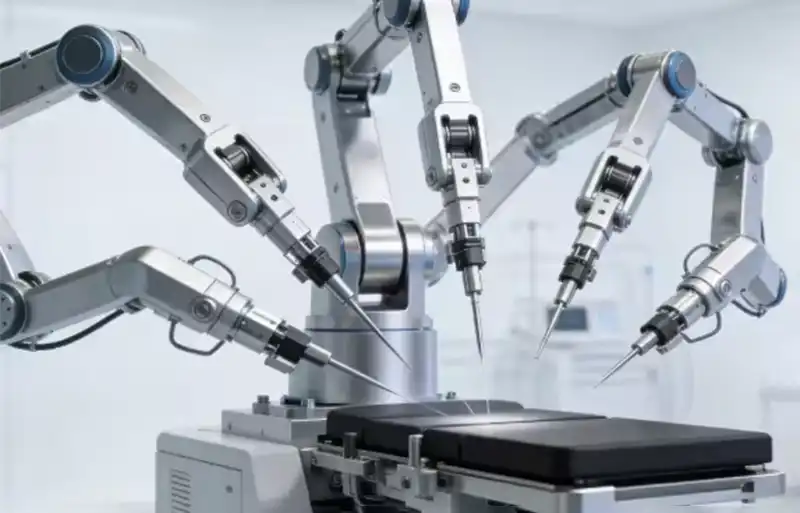
Beyond scalpels and forceps, CNC machining delivers instruments for minimally invasive robotics, microsurgery, and advanced laparoscopy:
- Non-Negotiables: Mirror finishes (Ra < 0.4 μm) to prevent bacterial adhesion, burr-free edges to avoid tissue trauma, and stress-relieved geometries for tactile feedback.
- High-Impact Examples: Robotic end-effectors, harmonic scalpels, laparoscopic staplers, biopsy needle housings.
- Material Criticality: ASTM F899 surgical stainless steel (17-4PH/316L), titanium alloys (Ti-6Al-4V), and cobalt-chrome for corrosion resistance during autoclaving.
Orthopedic Implants – Engineering the Human Frame
CNC-machined implants demand biomechanical precision and osseointegration compatibility:
- Key Components: Porous titanium spinal cages, patient-specific knee femoral components, trauma plates, and interference screws.
- Material Science: ASTM F136 ELI titanium (low ion release), PEEK polymer (radiolucency), and tantalum (bone-mimicking modulus).
- Technical Imperatives: Controlled surface roughness (3-5 μm Ra) for bone adhesion, topological optimization for load distribution, and stress-relieving heat treatments.
Diagnostic & Imaging Equipment – The Infrastructure of Detection
From MRI to portable ultrasound, CNC machining ensures vibration stability and EMI shielding:
- Core Applications: RF coil enclosures, CT scanner gantry components, X-ray collimators, and spectrometer mounts.
- Material Solutions: Non-magnetic alloys (aluminum 6061-T6, titanium), copper-beryllium (EMI shielding), and Ultem® (high-dielectric housings).
- Precision Demands: Flatness within 0.01mm/m for calibration surfaces, ISO 2768-mK tolerances for assembly interoperability.
Dental Solutions – Micro-Precision for Macro-Impact
Beyond crowns and bridges, CNC enables digital dentistry at scale:
- Expanding Frontiers: CAD/CAM abutments, zirconia implant bars, surgical guides, and orthodontic bracket systems.
- Biocompatibility Focus: Grade 5 titanium, zirconia, and Ceramic Injection Molding (CIM) composites.
- Accuracy Benchmarks: Sub-20μm fit tolerances for cementless implants, Ra < 0.2 μm surfaces to deter plaque.
Patient Monitoring & Life Support – Reliability in Critical Moments
Components where failure is not an option:
- Mission-Critical Parts: Ventilator flow sensors, infusion pump lead screws, dialysis machine valve bodies, defibrillator heat sinks.
- Material Resilience: USP Class VI plastics (PPSU, PEEK), anodized aluminum (thermal management), and antimicrobial copper alloys.
- Validation Requirements: Leak-test certifications (ISO 594-2), cleanroom assembly (ISO Class 7), and IEC 60601 electrical safety compliance.