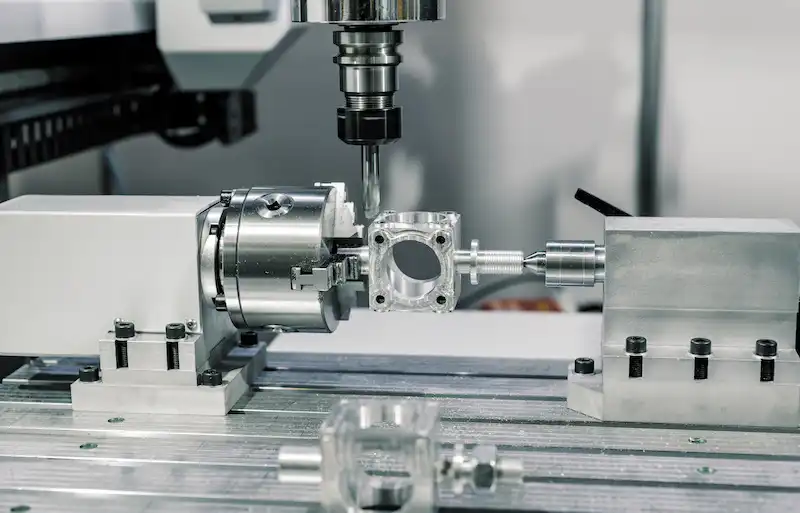
The core distinction between CNC turning and CNC milling is their fundamental motion:
- CNC Lathe (Turning): The workpiece rotates against a stationary cutting tool.
- CNC Milling: A rotating cutting tool moves against a fixed workpiece.
This primary difference dictates their capabilities, leading to key operational contrasts:
| Aspect | CNC Lathe (Turning) | CNC Milling |
|---|---|---|
| Ideal Part Geometry | Rotational, radially symmetric parts (cylinders, cones) | Prismatic, flat, or complex 3D parts |
| Production Speed | Extremely fast for high-volume round parts | Slower per part, but offers unparalleled flexibility |
| Feature Complexity | Features along a single axis (e.g., tapers, threads) | Complex features (pockets, slots, 3D contours) |
| Cost Efficiency | Lower cost per part for high-volume rotational runs | Better for low/medium volumes of complex parts |
Choose a CNC lathe for high-speed production of round parts. Choose CNC milling for complex, multifaceted components requiring intricate detail.