CNC Swiss precision machining is a specialized manufacturing process designed for producing extremely small, intricate, and high-accuracy components. Unlike conventional CNC turning, Swiss-type lathes support the workpiece with a guide bushing while the cutting tool operates in close proximity. This eliminates deflection, making it possible to achieve tight tolerances and smooth finishes even on very slender parts.
For industries such as medical devices, aerospace, automotive, and electronics, CNC Swiss precision machining is indispensable. It not only ensures consistency across large production runs but also meets the stringent quality standards required for safety-critical and high-performance components.
What Is CNC Swiss Precision Machining
CNC swiss precision machining, often called Swiss-type turning, is a subtractive manufacturing process that originated in Switzerland to make watch components. Today, it is widely used to manufacture CNC precision machining parts where accuracy, repeatability, and surface quality are paramount.
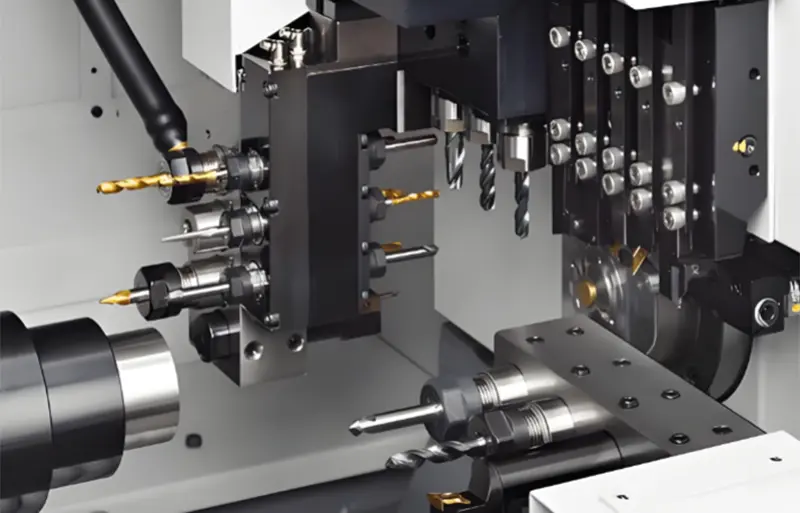
The process works by sliding the bar stock through a guide bushing while multiple tools operate simultaneously across several axes. This design allows for high-speed cutting and reduced vibration, enabling the production of parts with diameters as small as 1 mm and tolerances within ±0.002 mm.
Key characteristics of CNC swiss precision machining:
- Superior dimensional accuracy and surface finish.
- Ability to machine long, slender, or complex geometries.
- Efficiency in high-volume production with minimal secondary operations.
Advantages of CNC Swiss Precision Machining
Choosing CNC Swiss precision machining provides manufacturers with several advantages that directly impact product quality, cost-efficiency, and time-to-market.
1. Extreme Accuracy and Tight Tolerances
One of the most significant benefits of CNC Swiss precision machining is its capability to achieve ultra-tight tolerances. This makes it ideal for producing critical components such as surgical instruments, fuel injector parts, and aerospace connectors where precision is non-negotiable.
2. Enhanced Surface Quality
The guide bushing support minimizes deflection, ensuring smooth and consistent surface finishes. In many cases, this reduces the need for secondary polishing or finishing processes.
3. Complex Geometry Capability
Multi-axis Swiss CNC machines can handle intricate designs that combine turning, milling, drilling, and threading operations in a single setup. This reduces handling errors and improves efficiency.
4. Scalability for Production
Swiss machining excels in both prototyping and full-scale production. A reliable CNC precision machining company can easily scale from small pilot runs to high-volume manufacturing without sacrificing accuracy.
5. Cost Efficiency in Long Runs
Although setup costs may be higher initially, the ability to run complex parts in fewer steps significantly reduces cycle time and overall cost per unit in larger batches.
Applications of CNC Swiss Precision Machining Parts
CNC Swiss precision machining is trusted across industries where miniaturization, reliability, and high performance are critical. Some common applications include:
- Medical industry: Bone screws, dental implants, surgical tools.
- Aerospace sector: Electrical connectors, hydraulic fittings, engine components.
- Automotive field: Fuel injector nozzles, transmission pins, ABS system parts.
- Electronics: Micro-connectors, pins, and terminals for semiconductors.
- Industrial equipment: Precision shafts, valve components, and fasteners.